THE LINUX FOUNDATION PROJECTS
All Posts By

O-RAN SC

Title: RIC Testing as a Platform (RIC-TaaP): Advancing xApp/rApp Design and Testing towards Digital Twin network a Case Study with Orange and O-RAN Software Community (SC)

By Blog, Case Study

Author: Mina Yonan, Orange Innovation Egypt, mina.awadallah@orange.com

Problem 

The adoption of the RAN Intelligent Controller (RIC) in networks encounters several challenges that may impede its objective and efficiency. To enable efficient and plug-and-play use cases, we can categorize these challenges into two key areas:

  • Legacy SON Platform Limitations: The development and operational life-cycle of Self-Organizing Network (SON) modules is inherently slow due to the absence of a robust testing framework. The lack of a digital twin environment for network simulation and validation significantly hampers efficiency. Moreover, traditional SON platforms are not inherently designed to evolve with AI-driven methodologies, limiting their adaptability to dynamic network conditions and next-generation automation frameworks.
  • High Barriers to Entry for xApp/rApp Ecosystem: A fundamental advantage of RIC is its ability to foster an open, interoperable ecosystem where third-party applications can be seamlessly integrated through standardized interfaces. However, the high costs associated with xApp/rApp testing and certification present a major hurdle for independent software vendors (ISVs), researchers, and academia. While RIC has expanded the ecosystem beyond traditional network equipment vendors to include a diverse set of stakeholders—such as Communication Service Providers (CSPs) and academic institutions—the financial and technical burdens of testing remain a key inhibitor to broader adoption and innovation.

Action

To address the aforementioned challenges, Orange has announced the development of RIC Testing as a Platform (RIC-TaaP)—an open source initiative designed to streamline xApp/rApp functional and operational testing, fostering innovation in xApp/rApp design and provide a proven digital-twin networks.

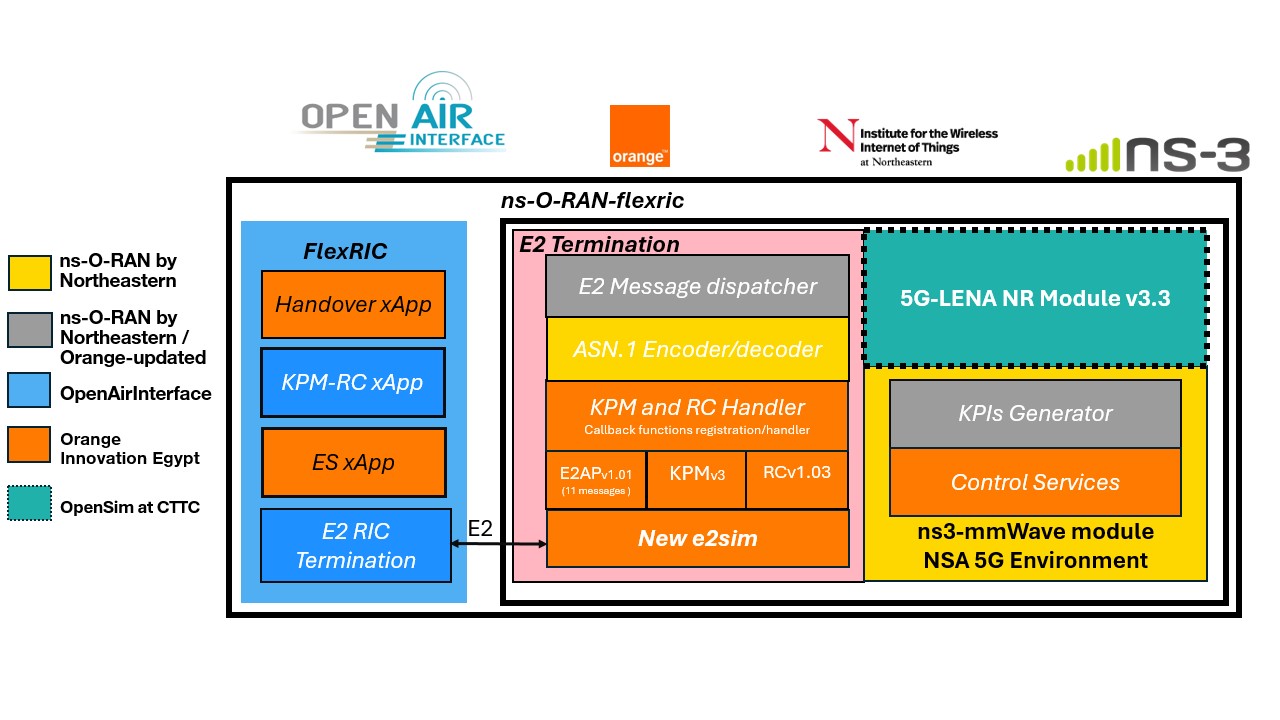
Recognizing the need for a robust, fully open source testing environment, Orange Innovation Egypt (OIE) has focused on enabling system-level use cases by leveraging advanced open source components. To achieve this, OIE has integrated FlexRIC from EURECOM with the ns-O-RAN simulator, originally developed by the Institute for the Wireless Internet of Things (WIoT) ,University of Padova and Mavenir. The team has enhanced the simulator to ensure full compliance with E2AP v1.01, KPM v3, and RC v1.03 standards, providing a sophisticated 5G simulation environment for validating complex use cases.

Additionally, Orange Innovation Poland (OIP) has augmented the platform with a user-friendly dashboard, RIC-TaaP Studio, enabling intuitive test scenario design and incorporating a range of operational features. Across its innovation centers, Orange continues to integrate leading open source solutions, including the 5G-LENA module, developed by the OpenSim Research Unit at the Centre Tecnològic de Telecomunicacions de Catalunya (CTTC).

Committed to openness and accessibility, Orange ensures that RIC-TaaP remains an open source and user-friendly platform, making Open RAN research and development more accessible to a broader community of engineers and researchers.
Key Components of RIC-TaaP
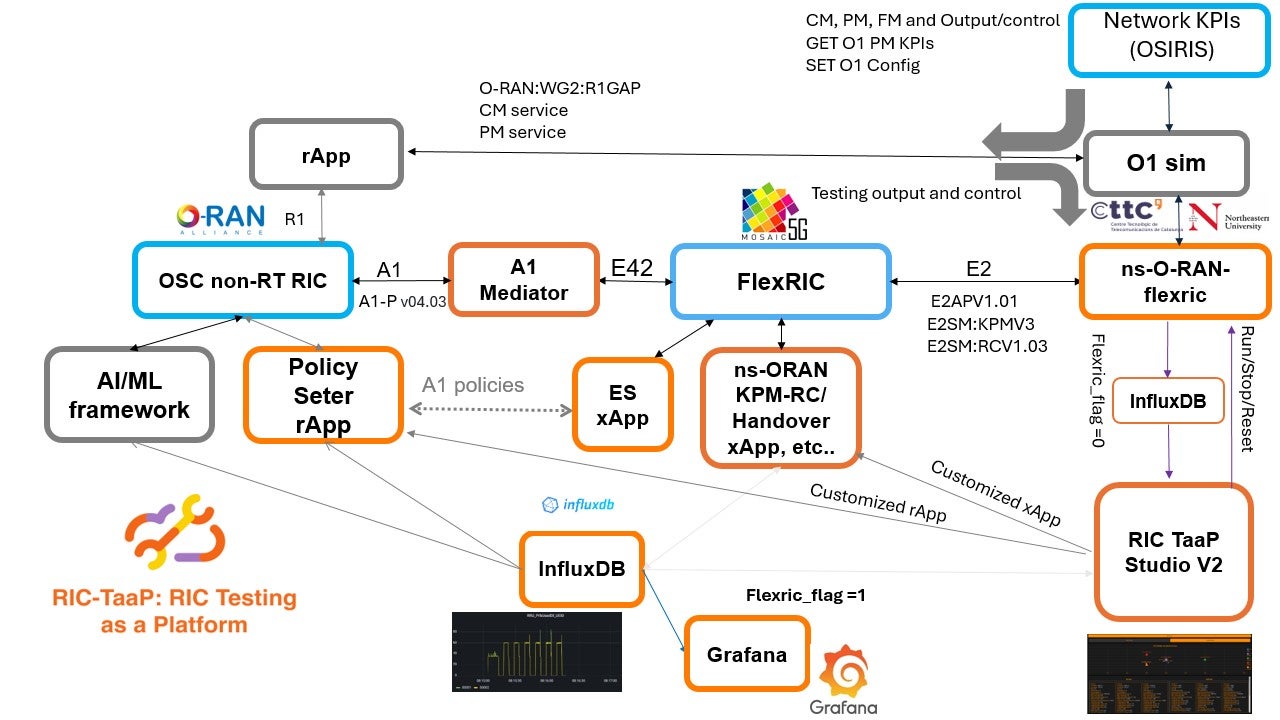
To establish a fully capable platform for xApp/rApp design and testing, RIC-TaaP comprises nine key components. These elements collectively form a flexible and robust network simulation environment, enabling efficient xApp/rApp development, validation, and deployment.

  1. FlexRIC – the implementation of the Near-RT RIC functionality, developed by EURECOM under the Mosaic5G project.
  2. NONRTRIC – Represents the Non-RT RIC functionality, developed by the O-RAN Software Community (OSC).
  3. ns-O-RAN SimulatorOIE introduces an enhanced version of the ns-O-RAN simulator, originally developed by the WIoT at Northeastern University. This upgraded version now supports standardized E2AP (11 messages) and service models, including KPMv3 and RCv1.03. Additionally, the E2 termination has been optimized for full compliance with FlexRIC E2 termination, ensuring seamless interoperability.
E2APv1.01E2 SETUP REQUEST​
E2 SETUP RESPONSE​
RIC SUBSCRIPTION REQUEST​
RIC SUBSCRIPTION RESPONSE​
RIC SUBSCRIPTION FAILURE​
RIC INDICATION
RIC CONTROL REQUEST​
RIC CONTROL ACKNOWLEDGE​
RIC SUBSCRIPTION DELETE FAILURE​
RIC SUBSCRIPTION DELETE REQUEST​
RIC SUBSCRIPTION DELETE RESPONSE​
KPMv3List of KPIs supported by ns-O-RAN 
RCv1.03  – CONTROL Service Style 3 (Section 7.6)   – Connected Mode Mobility Management (Section 7.6.4)   – Control Action ID 1 (Handover Control) (Section 8.4.4.1)   – Control Action ID 2 (Conditional Handover Control) (Section 8.4.4.2)   – Control Action ID 3 (DAPS Handover Control) (Section 8.4.4.3)
  1. 5G-LENA NR module: To extend the simulation capabilities, the team integrates the 5G-LENA module that covers the SU-MIMO and Enhanced PHY/MAC layer capabilities.
  2. A1 MediatorOIP introduces a new version of OSC A1 mediator that can transfer A1 Policy Management (A1-P) into internal FlexRIC’xApps to smoothly transfer A1-P to xApp logic and operation.
  3. O1sim:  Represents the O1 termination of the ns-O-RAN-FlexRIC platform, enabling Performance Measurement (PM) and Configuration Measurement (CM) in O1 NETCONF format. This ensures smooth integration of Service Management and Orchestration (SMO).
  4. OSIRIS:  Moving towards a Digital Twin network, RIC-TaaP incorporates the OSIRIS tool, which enables vendor-specific KPI monitoring across different time frames. This tool—or any equivalent alternative—plays a key role in AI-driven rApp development, facilitating the exchange of control actions with twin networks via the ns-O-RAN-FlexRIC platform.
  5. RIC-TaaP Studio: RIC TaaP Studio allows users to run ns-3 simulations without needing a deep development background. It provides real-time monitoring of simulation status and key performance indicators (KPIs) for Cells and UEs, with more features planned for future releases. RIC TaaP Studio integrates a powerful combination of a graphical user interface (GUI), InfluxDB, and Grafana. The OIP team developed both the backend and frontend for the GUI and made enhancements to the ns-3 simulator to enable GUI interactions.  
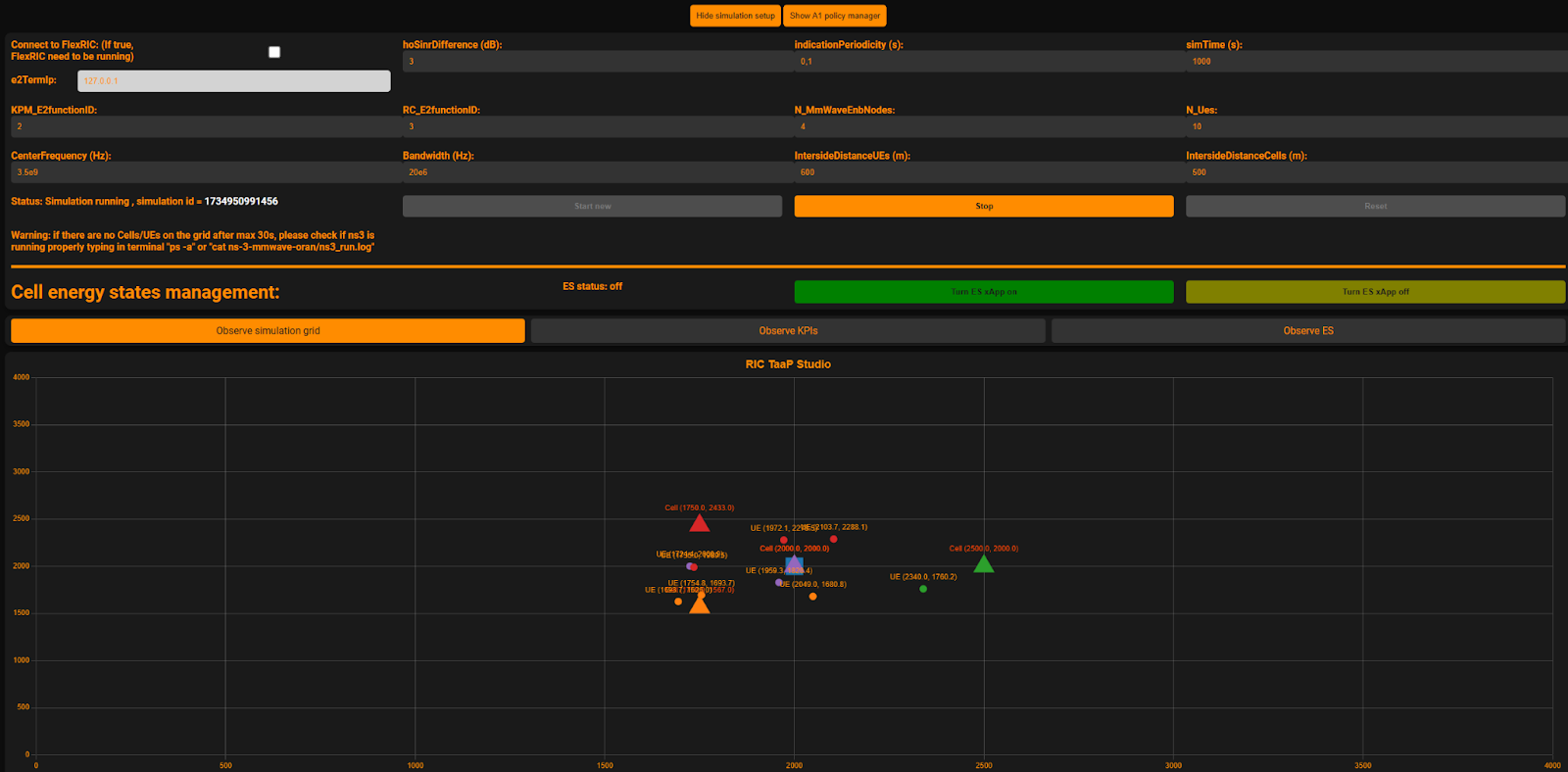
  1. xApp/rApp Examples: The team provide a E2E Energy Saving usecase that include:
  • Control Actions: the team implemented the Mobility Management according RCv1.03 to initiate Hand Over (HO) commands.
  • Reported KPIs: the team extends the reported KPIs from the ns-3 simulator to support a wide number of KPIs suitable for different xApp usecases.
  • RIC-TaaP studio dashboards: The dashboard includes a new visualization tap for Energy Saving sub-usecase “cell/carrier switch ON/Off” in terms of the saving gain and performance KPIs to monitor the network before and after the xApp/rApp operation.  

Results

Use-case 21: Energy Saving under Cell Utilization “Cell on/off” as an example

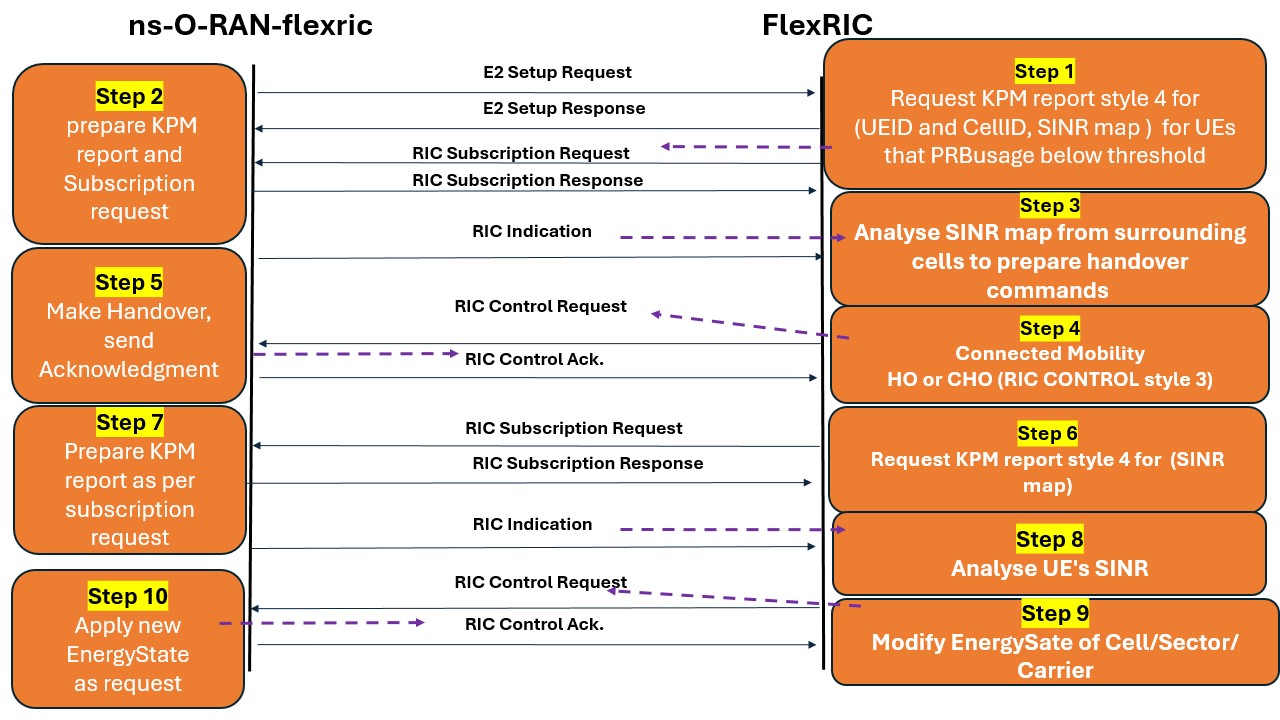
The Energy Saving (ES) logic example in RIC-TaaP is driven by cell utilization, particularly Physical Resource Block (PRB) usage (%). The decision-making process follows a structured sequence, as illustrated in the diagram below:

Sequence of Operations After xApp Execution

  1. xApp Requests KPM Report
    • The xApp triggers a KPM Report (Style 4) request for UEs where PRB usage falls below the defined threshold.
  2. E2 Termination Processes KPM Report Request
    • The E2 termination at ns-O-RAN-FlexRIC prepares the KPM report and subscription request for the relevant UEs.
  3. xApp Analyzes SINR Map
    • The xApp evaluates the SINR map of surrounding cells to determine suitable candidates for handover.
  4. xApp Sends Handover (HO/CHO) Commands
    • The xApp initiates a Connected Mobility procedure by sending Handover (HO) or Conditional Handover (CHO) commands using RIC CONTROL Style 3.
  5. ns-O-RAN-FlexRIC Executes Handover
    • The handover is executed, and the E2 termination at ns-O-RAN-FlexRIC sends an acknowledgment to confirm the procedure.
  6. xApp Requests Updated KPM Report for SINR Map
    • The xApp requests another KPM Report (Style 4) to obtain an updated SINR map post-handover.
  7. E2 Termination Generates Updated KPM Report
    • The ns-O-RAN-FlexRIC prepares the requested KPM report based on the latest subscription request.
  8. xApp Analyzes UE SINR Post-Handover
    • The xApp evaluates the new SINR values for UEs after mobility decisions.
  9. xApp Modifies Energy State
    • Based on SINR and cell utilization, the xApp adjusts the Energy State of the Cell/Sector/Carrier to optimize power consumption.
  10. ns-O-RAN-FlexRIC Applies New Energy State
  • The ns-O-RAN-FlexRIC enforces the new Energy State configuration as requested by the xApp.
The Energy Dashboard in RIC-TaaP Studio provides real-time monitoring of network performance and energy efficiency metrics. It includes three key categories:

1. QoS Parameters

  • L3 SINR (dB): Displays the Signal-to-Interference-plus-Noise Ratio (SINR) for all UEs in the scenario, measured at Layer 3.
  • PRB Usage (%): Indicates the Physical Resource Block (PRB) utilization for each cell in the scenario.
  • Total Downlink Transport Block Errors (ErrTotalNbrDl): Represents the cumulative number of downlink transport block errors detected on the UE side.

2. Energy Consumption Metrics

  • Energy Consumption (J): Measures the total energy consumption before and after xApp execution, allowing for comparative analysis of energy efficiency improvements.
  • Average Power Consumption (W): Calculates the average power consumption across all cells in the scenario.

3. Energy State Mode

  • Cell Power-Off Flag: Displays an indicator for each cell, signaling whether it has been switched off as part of energy-saving mechanisms.

Orange Team Leaders & Members

Domain Leader:  Eric Hardouin, Orange Innovation, eric.hardouin@orange.com ​

Program Leader: Fabrice Guillemin, Orange Innovation, fabrice.guillemin@orange.com

Project Leader:  Alassane Samba​,Orange Innovation, alassane.samba@orange.com

Contributors

Project Links

O-RAN ALLIANCE Broadens Its Industry Collaboration with ETSI, Announces its 3rd Whitepaper, and 4th Release of Open Software

By News


• 3rd O-RAN whitepaper focuses on O-RAN Minimum Viable Plan and commercialization
• O-RAN ALLIANCE sets cooperation with ETSI and TSDSI
• New Open Test and Integration Centers approved in Europe and Taiwan
• New Standards Collaboration Copyright License to simplify the open source development
• “D” release of open software for the RAN developed by the O-RAN Software Community

“The “D” release delivers major enhancements including support for closed-loop processing use cases,
continued evolution of Non-Real-Time RAN Intelligent Control (Non-RT RIC) platform, new and
enhanced xApps for the Near-Real-Time Radio Intelligent Controller (Near-RT RIC), as well as new
performance monitoring and alarm support.”

Read more on O-RAN Alliance Release

O-RAN ALLIANCE Delivers New Specifications, “Bronze” Open Source Software and New Virtual Exhibits of O-RAN Solutions

By News
  • O-RAN has recently published 23 new or updated specifications and the O-RAN Use Cases and Deployment Scenarios white paper
  • The 2nd release of O-RAN software “Bronze” adds support for new key elements of the O-RAN architecture and updates aligned with the latest O-RAN specifications
  • O-RAN Virtual Exhibition adds more demonstrations of O-RAN based technologies

Bonn/Germany, July 1, 2020 – The O-RAN ALLIANCE has continued its progress towards making the Radio Access Networks (RAN) truly open, intelligent, virtualized and fully interoperable.

The O-RAN ALLIANCE welcomes TELUS Communications Inc. and U.S. Cellular as new operator members, bringing the total to 26 major carriers. O-RAN now has over 200 companies driving the definition and realization of O-RAN technology.

Recently Released Specifications and White Paper

Published in February 2020, the O-RAN Use Cases and Deployment Scenarios white paper introduces the initial set of O-RAN use cases and cloud native deployment support options.

O-RAN use cases drive the O-RAN architecture and demonstrate its unique benefits, including utilization of AI/ML modules to empower network intelligence through open and standardized interfaces in a multi-vendor network. The white paper also introduces the O-Cloud cloud computing platform that can host relevant O-RAN functions to enable flexible deployment options in virtualized telco clouds.

Recently published specifications bring new or updated features to all parts of the O-RAN architecture, allowing vendors to progress with improved O-RAN based implementations. For more details, please check this O-RAN Blog post.

O-RAN Software Community Bronze Release

On June 21, 2020, working with the Linux Foundation, the O-RAN SW Community published its second SW release dubbed “Bronze.” The software adds support for new key elements of the O-RAN architecture and provides updates to align with the latest O-RAN specifications:

  • The initial release of an A1 policy manager and an A1 controller that implements the Non-Real-Time Radio Intelligent Controller (Non-RT RIC) architecture.
  • The Near-Real-Time RIC updated to current O-RAN E2 and A1 specifications with 5 sample xAPPs.
  • Initial O-CU and O-DU Low/High code contributions that support a FAPI framework and integration between the O-DU and RIC with E2 functionality and subscription support.
  • A Traffic Steering and Quality Prediction use case leveraging an E2 interface data ingest pipeline to demonstrate the functionality of RAN traffic steering with an E2 interface KPI monitoring capability.
  • OAM use cases that exercise Health Check call flows including the Near-RT RIC and its O1 and A1 interfaces.

“The new use cases, the Bronze software release, and the new O-RAN ALLIANCE members are indications that this global forum is working exactly as intended, reaching across borders to drive innovation and build consensus,” said Andre Fuetsch, Chairman of the O-RAN ALLIANCE and Chief Technology Officer – Network Services, at AT&T. “As this coalition evolves, we look forward to seeing how it continues to broaden access to 5G and other new access technologies.”

“Over the past 6 months, O-RAN working groups and the O-RAN Software Community have extensively engaged to achieve tight alignment between the specifications and the Bronze release open source code,” said Chih-Lin I, the Co-Chair of O-RAN Technical Steering Committee. “Specific progress related to both the Non-RT-RIC and the Near-RT-RIC frameworks and associated key interfaces deserves special mention for its importance in enabling AI/ML capabilities in RAN. The O-RAN virtual showcase further demonstrates the growing momentum towards global adoption and deployment of O-RAN solutions.”

“Ericsson is actively engaged in shaping the future of the O-RAN initiative by enabling Non-RT RIC (Non-Real-Time RAN Intelligent Controller) and A1 interface to support fine-grained intelligent steering of the RAN,” said Per Beming, Head of Standards and Industry Initiative in Ericsson. “During OSC Bronze release, Ericsson continued as the key contributor to Non-RT RIC project by improving support for intent based intelligent RAN optimization using A1 interface. This specific capability allows operators to leverage both RAN and non-RAN data to enrich end user experience.”

“The work within the O-RAN ALLIANCE is a great example of how strong industry collaboration can help accelerate technology innovation,” said Udayan Mukherjee, Intel Fellow, Network Platforms Group and Chief Technologist, Wireless Infrastructure, at Intel. “As a major contributor to the FAPI library specifications, architectures and software in O-RAN, Intel is pleased to see how this work can enable an O-RAN Distributed Unit platform that is compliant with O-RAN standardized stack interfaces.”

“The O-RAN Software Community has reached an important achievement with its second software release. This milestone is the result of a tremendous effort from across the O-RAN community,” said Gil Hellmann, vice president, Telecom Solutions Engineering, Wind River. “As the lead for the INF project delivering the edge cloud infrastructure portion for the O-RAN workgroup based on the Yocto and StarlingX open source projects, Wind River looks forward to continuing our contributions to the community to accelerate the commercialization of 5G vRAN.”

To learn more about the O-RAN Software Community “Bronze” release please read this O-RAN Blog post, and to access the code, check out the O-RAN Software Community website.

The O-RAN Software Community has been open to any participants that want to get involved in the creation of software for future RAN – for more details please visit https://www.o-ran.org/software.

Expanded O-RAN Virtual Exhibition
With the cancelation of MWC-Barcelona, on April 21, 2020 the O-RAN ALLIANCE created an online showcase. The O-RAN Virtual Exhibition includes demonstrations of real O-RAN based equipment in the form of videos, animations, charts and text.

The Virtual Exhibition currently hosts 31 demos presented by 38 O-RAN companies. O-RAN plans to keep adding more content and features to make its virtual showcase a valuable tool for RAN industry players to present real-world solutions embodying O-RAN’s architecture and specifications.

In addition to previously announced demos, O-RAN member companies have recently created 12 new virtual demonstrations of real O-RAN technology:

The first demo sponsored by SageRAN demonstrates end to end high throughput traffic running over through SageRAN’s 5G Stand Alone Open RAN Stack. This demo includes both X86 and ARM based O-DU/O-CUs and an eCPRI based O-RU.

The second demo sponsored by Keysight demonstrates Keysight’s O-RAN Test Solution for O-RUs. This test suite enables NEM development/manufacturing, Operator, and OTIC Labs to accelerate O-RU conformance testing.

The third demo sponsored by VIAVI demonstrates VIAVI’s O-RAN validation Solution for O-CU subsystem test. This complete wraparound framework enables NEMs, Operators, OTIC Labs and integrators to ensure that the O-CU can be robustly tested and optimized for high-quality and performance.

The fourth demo sponsored by Benetel demonstrates a 5G Non Standalone (NSA) platform comprised of Benetel’s product family of 4G & 5G Remote Radio Units, developed in compliance with the O-RAN specification, and a O-CU & O-DU implementation that is based on the OAI software stack and supports O-RAN’s 7.2x open fronthaul specification.

The fifth demo sponsored by Parallel Wireless demonstrates a unified 2G through 5G cloud-native O-RAN solution. This makes Parallel Wireless’s software-based Open RAN stack easy to manage and delivers cost-savings to MNOs using it to modernize or expand their networks.

The sixth demo sponsored by ArrayComm showcases two O-RAN Whitebox demonstrations: The first demo is an end to end demo using an ARM Based Multi-vendor Whitebox 5G gNB. The second demo demonstrates a Whitebox’s FPGA real time downlink bit processing (CRC, FEC, RateMatching) and uplink bit (CRC, FEC, RateMatching, HARQ) processing throughput test.

The seventh demo sponsored by Lenovo and NTS demonstrates an integrated small cell solution based on cloudification and virtualization. This demo showcases the decoupling of hardware and software based on O-RAN architectural principles.

The eighth demo sponsored by NVIDIA demonstrates an O-RAN Open Fronthaul-based hyper converged 5G CloudRAN, Core Network and MEC solution for the edge. This demo showcases the value of NVIDIA GPU and Mellanox SmartNIC-based, cloud-native, and scalable NVIDIA EGX platform, that enables software-defined, high performance and low latency solution on COTS servers.

The ninth demo sponsored by Comba Telecom showcases macro open RAN high efficiency multi-RAT RRU solution fully compliant with the O-RAN architecture supporting Split 7-2x and Split 8 fronthaul interface to O-DU, as well as E2E 5G NR indoor Open RAN solution built upon Intel-based server platform and Intel FPGA.

The tenth demo sponsored by Baicells, QCT and Keysight demonstrates the 5G SA indoor pico cell solution with multiple O-RUs via Fronthaul Gateway based on Indoor Pico Cell (IPC) Hardware Reference Design (HRD). To verify the performance of IPC HRD, the multi-UE emulator is used to test the cell merging as well as active UE numbers.

The eleventh demo sponsored by Baicells, QCT, Wind River, Keysight and China Unicom demonstrates the E2E Indoor Pico Cell solution based on IPC HRD and Open Cloud platform. In addition, the co-platform for both O-CU/O-DU and 5GC are tested with multi-UE emulator to showcase the commercial readiness for practical deployment.

The twelfth demo sponsored by Ericsson illustrates how the OSC (O-RAN Software Community) A1 controller function supports QoE refinement in RAN through the use of A1 policies. This specific capability allows operators to implement policy aware service assurance, application aware QoE prioritization and perform continuous evaluation of current vs. target QoE. O-RAN’s Non-RT RIC function and A1 interface enable fine-grained and intelligent control of the RAN.

About O-RAN ALLIANCE
O-RAN ALLIANCE is a world-wide community of over 200 mobile operators, vendors, and research & academic institutions operating in the Radio Access Network (RAN) industry. As the RAN is an essential part of any mobile network, O-RAN ALLIANCE’s mission is to re-shape the industry towards more intelligent, open, virtualized and fully interoperable mobile networks. The new O-RAN standards will enable a more competitive and vibrant RAN supplier ecosystem with faster innovation to improve user experience. O-RAN-compliant mobile networks will at the same time improve the efficiency of RAN deployments as well as operations by the mobile operators. To achieve this, O-RAN ALLIANCE publishes new RAN specifications, releases open software for the RAN, and supports its members in integration and testing of their implementations.
For a short video describing O-RAN’s progress, see www.o-ran.org/videos
For more information please visit www.o-ran.org

For more information, contact:
O-RAN ALLIANCE PR Contact
Zbynek Dalecky
pr@o-ran.org
O-RAN ALLIANCE e.V.
Buschkauler Weg 27
53347 Alfter/Germany